
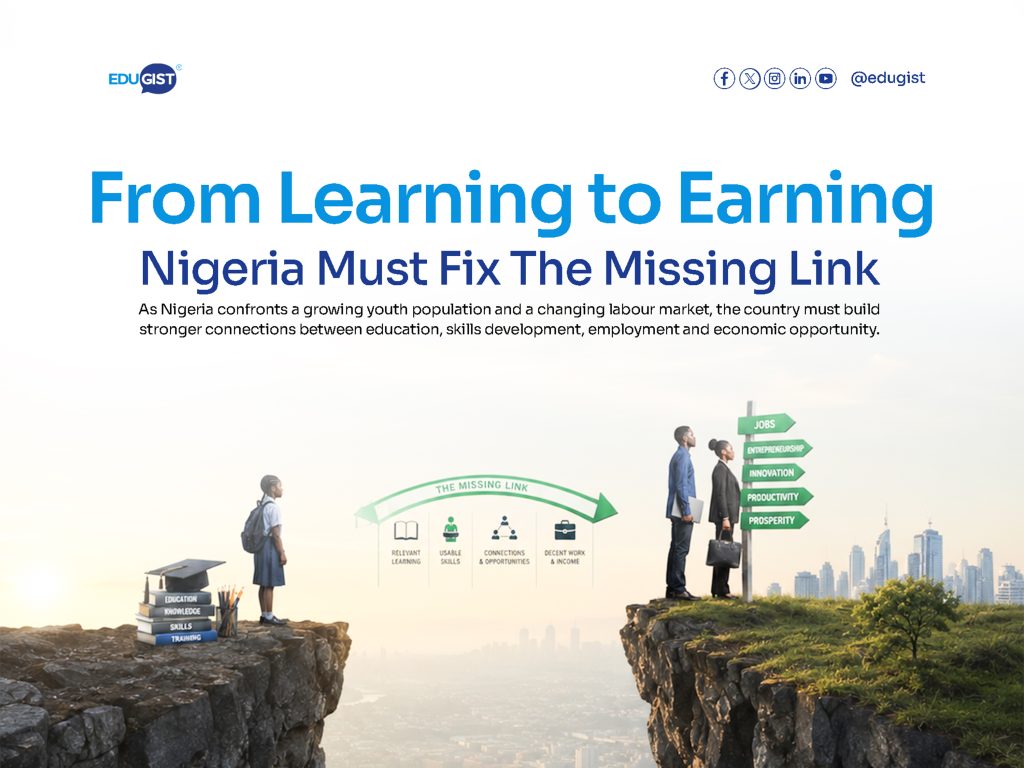

For years, Nigeria has treated education largely as an end in itself. The dominant measures of progress have been familiar: how many children are enrolled in school, how many classrooms have been built, how many students graduate from secondary school, how many obtain university degrees and, increasingly, how many young people pass through various skills-acquisition programmes.
These measures matter, but they tell only part of the story. The more consequential question for a country confronting a rapidly growing population and persistent economic pressures is what happens to people after they have learned.
That question takes centre stage at the 32nd Nigerian Economic Summit Group (NES #32) Pre-Summit Event, themed “The Missing Link: From Learning to Earning,” being held virtually today, September 3, 2026.
The conversation brings together stakeholders from education, technology, finance, skills development and social-impact organisations to examine one of Nigeria’s most persistent structural problems: the weak connection between what people learn and their ability to secure productive livelihoods.
It is a timely conversation because Nigeria’s education challenge is no longer adequately described simply as a problem of access. The country certainly still has significant access and participation challenges, particularly at the basic education level, but even where young Nigerians make it through the education system, there remains a troubling disconnect between educational attainment and economic opportunity.
A certificate may open a door, but increasingly, it does not guarantee that there is a viable pathway on the other side.
The result is an education-to-employment transition that is often left almost entirely to the individual.
A young person completes secondary school and is expected to determine the next step. Another spends four or more years at university, completes national service and enters a labour market where employers complain about skills gaps and applicants complain about a lack of opportunities.
Another acquires a vocational skill through an informal apprenticeship but has limited access to finance, equipment, technology or markets. Yet another completes one of the many government or donor-supported skills programmes but discovers that the training itself has not necessarily created a pathway to employment.
Each of these experiences looks different, but they point to the same structural weakness: Nigeria has not built a sufficiently strong bridge between learning and economic participation.
𝗘𝗗𝗨𝗖𝗔𝗧𝗜𝗢𝗡 𝗔𝗡𝗗 𝗧𝗛𝗘 𝗘𝗖𝗢𝗡𝗢𝗠𝗬 𝗖𝗔𝗡𝗡𝗢𝗧 𝗖𝗢𝗡𝗧𝗜𝗡𝗨𝗘 𝗢𝗣𝗘𝗥𝗔𝗧𝗜𝗡𝗚 𝗜𝗡 𝗦𝗘𝗣𝗔𝗥𝗔𝗧𝗘 𝗥𝗢𝗢𝗠𝗦
Part of the problem is that Nigeria’s education debate has traditionally been conducted separately from its economic debate. Education policymakers discuss curriculum, teachers, examinations, infrastructure and learning outcomes, while economic policymakers focus on jobs, investment, productivity, industrialisation and growth. The keynote speaker of the session, Abubakar Suleiman, buttressed on this.
These are treated as related areas, but too rarely as parts of the same system.
They are, in reality, inseparable. And I am writing on this as part of my Education Angle column.
An economy cannot become significantly more productive if its workforce does not possess the knowledge and capabilities required to participate in that economy. At the same time, an education system cannot fulfil its wider social and economic purpose if the economy does not create sufficient opportunities for people to apply their capabilities.
This is why the phrase “learning to earning” deserves more attention than simply as a convenient theme for an economic summit. It describes a chain of relationships that should sit at the centre of national development planning: children must acquire foundational learning; young people must build relevant technical, digital and human skills; education institutions must connect learners to the realities of work; businesses must participate in developing talent; and the economy must create opportunities in which those capabilities can be converted into productivity and income.
Where one part of that chain fails, the consequences are felt throughout the system.
A student who does not develop strong literacy and numeracy skills in the early years will struggle to acquire more advanced knowledge later. A secondary school graduate without adequate problem-solving, communication or technical capabilities may find it difficult to compete for decent work.
A university graduate whose education has remained disconnected from contemporary industry requirements may possess a qualification without possessing the competencies an employer needs. And even a well-trained young person can remain economically excluded if there are too few businesses, jobs, markets or financing opportunities available.
The problem, therefore, is bigger than curriculum reform.
𝗪𝗘 𝗡𝗘𝗘𝗗 𝗧𝗢 𝗦𝗧𝗢𝗣 𝗔𝗦𝗞𝗜𝗡𝗚 𝗢𝗡𝗟𝗬 𝗪𝗛𝗔𝗧 𝗦𝗧𝗨𝗗𝗘𝗡𝗧𝗦 𝗔𝗥𝗘 𝗟𝗘𝗔𝗥𝗡𝗜𝗡𝗚
There is an important shift that Nigeria needs to make in how it evaluates education. The question should no longer be limited to what schools and universities are teaching; policymakers should also be asking what learners are actually able to do as a result of that education.
This distinction is critical.
A curriculum can contain entrepreneurship, digital literacy, financial literacy or career education without necessarily producing entrepreneurial, digitally capable or financially literate young people. A university can establish a computer science programme without necessarily producing graduates capable of solving real-world technology problems.
A skills programme can train thousands of young people without establishing whether those participants subsequently find employment, start sustainable businesses or increase their earnings.
This is where the conversation about outcomes becomes particularly important.
Nigeria has become accustomed to reporting inputs and activities: numbers of schools built, teachers trained, students enrolled, young people reached and participants certified. What is less consistently tracked is what happens afterwards.
Did learning improve? Did skills translate into employment? Did income increase? Did productivity improve? Did the business survive? Did the young person become more economically resilient?
These are much harder questions, but they are the questions that ultimately determine whether public and private investments in education are producing the results Nigeria needs.
A genuine learning-to-earning framework would therefore require government and its partners to follow people beyond the classroom and training centre. It would connect education data with labour-market data and create much better feedback between employers and education providers.
It would also make it possible to identify which programmes actually improve people’s economic prospects and which merely produce impressive participation numbers.
𝗧𝗛𝗘 𝗨𝗡𝗜𝗩𝗘𝗥𝗦𝗜𝗧𝗬 𝗗𝗘𝗚𝗥𝗘𝗘 𝗦𝗛𝗢𝗨𝗟𝗗 𝗡𝗢𝗧 𝗕𝗘 𝗧𝗛𝗘 𝗢𝗡𝗟𝗬 𝗗𝗘𝗙𝗜𝗡𝗜𝗧𝗜𝗢𝗡 𝗢𝗙 𝗦𝗨𝗖𝗖𝗘𝗦𝗦
Nigeria also needs to rethink the hierarchy it has created around different forms of education.
For many families, university remains the preferred destination because a degree is still perceived as the safest route to social mobility and economic security. That aspiration is understandable, particularly in a country where education has historically transformed the prospects of individuals and families.
But an economy cannot be built entirely around university graduates, nor can every young person be expected to follow the same educational pathway.
Nigeria needs engineers and economists, but it also needs electricians, plumbers, mechanics, agricultural technicians, welders, construction workers, healthcare assistants, software developers, designers, machine operators, artisans and thousands of other skilled professionals.
The modern economy does not function because everyone possesses the same qualification; it functions because people possess different capabilities that complement one another.
The challenge is therefore not to replace university education with vocational education or to present one as superior to the other. The challenge is to build a system in which multiple pathways are respected, properly funded and connected to genuine economic opportunities.
That means making technical and vocational education more attractive, but it also means reforming the way vocational skills are acquired.
Nigeria’s informal apprenticeship system already trains huge numbers of young people, particularly in trades and small businesses. Rather than treating this system as peripheral to formal education, policymakers should examine how its strengths can be supported with better standards, technology, certification, business skills, access to finance and stronger connections to formal markets.
The same principle applies to entrepreneurship.
It is increasingly common to tell young Nigerians that they should become entrepreneurs because the formal labour market cannot absorb everyone. Entrepreneurship can certainly create opportunities, but it should not become a convenient excuse for failing to create an economy in which businesses can actually survive and grow.
Giving a young person entrepreneurship training without access to finance, markets, infrastructure and a predictable business environment is unlikely to produce the transformation policymakers hope for.
𝗧𝗿𝗮𝗶𝗻𝗶𝗻𝗴 𝘄𝗶𝘁𝗵𝗼𝘂𝘁 𝗼𝗽𝗽𝗼𝗿𝘁𝘂𝗻𝗶𝘁𝘆 𝗶𝘀 𝗻𝗼𝘁 𝗮 𝗰𝗼𝗺𝗽𝗹𝗲𝘁𝗲 𝘀𝗼𝗹𝘂𝘁𝗶𝗼𝗻.
𝗧𝗛𝗘 𝗣𝗥𝗜𝗩𝗔𝗧𝗘 𝗦𝗘𝗖𝗧𝗢𝗥 𝗠𝗨𝗦𝗧 𝗕𝗘𝗖𝗢𝗠𝗘 𝗔 𝗖𝗢-𝗢𝗪𝗡𝗘𝗥 𝗢𝗙 𝗧𝗛𝗘 𝗘𝗗𝗨𝗖𝗔𝗧𝗜𝗢𝗡 𝗖𝗢𝗡𝗩𝗘𝗥𝗦𝗔𝗧𝗜𝗢𝗡
The private sector also has an important role to play in closing the gap.
For years, employers have complained that graduates are not sufficiently prepared for the workplace. That criticism cannot simply be directed at universities and schools. Businesses themselves need to become more active participants in shaping the workforce they require.
This means expanding internships, apprenticeships, graduate trainee programmes, mentorship, industry-led projects and workplace learning. It means creating stronger relationships between companies and educational institutions so that students can encounter real-world problems before graduation rather than after they enter the labour market.
It also means recognising that skills development does not end when someone gets a job. In a rapidly changing economy, workers will have to continue learning throughout their careers.
Artificial intelligence, automation, digital platforms, climate change, new production technologies and changing business models are already altering the nature of work. The education system must prepare people not only for their first job but for a labour market in which they may need to repeatedly acquire new capabilities.
This is particularly important for Nigeria because the country has the opportunity to benefit from a young and increasingly connected population. A large youthful population can become a tremendous economic asset when people are healthy, educated, skilled and productively employed.
Without those conditions, however, population growth can intensify pressure on schools, labour markets and public services.
The demographic question is therefore also an education question, and ultimately an economic question.
𝗙𝗥𝗢𝗠 “𝗝𝗢𝗕-𝗥𝗘𝗔𝗗𝗬 𝗚𝗥𝗔𝗗𝗨𝗔𝗧𝗘𝗦” 𝗧𝗢 𝗔𝗡 𝗢𝗣𝗣𝗢𝗥𝗧𝗨𝗡𝗜𝗧𝗬-𝗥𝗘𝗔𝗗𝗬 𝗦𝗢𝗖𝗜𝗘𝗧𝗬
There is another subtle but important distinction Nigeria should make. The goal of education should not be to produce graduates who are merely job-ready. It should be to produce people who are opportunity-ready.
A job is one form of economic opportunity, but it is not the only one.
A young Nigerian might become an employee, establish a business, join an existing family enterprise, work as a skilled artisan, become a farmer using modern technology, develop a digital service for international clients or combine several income-generating activities.
What matters is whether the education system has equipped that person with the foundational knowledge, technical competence, adaptability, confidence and problem-solving ability to navigate these possibilities.
That requires a broader understanding of employability and economic participation.
Literacy and numeracy remain fundamental. So are science and technology. But communication, critical thinking, collaboration, creativity, financial capability, digital competence and the ability to keep learning are becoming equally important.
The education system must develop these capabilities while ensuring that learners acquire the technical knowledge required by particular industries and occupations.
This is why the learning-to-earning conversation should begin much earlier than university graduation. Young people should be exposed to careers, workplaces, entrepreneurship and the changing nature of work while they are still making educational choices.
Career guidance should not be an occasional lecture in secondary school; it should become a meaningful component of education.
𝗡𝗜𝗚𝗘𝗥𝗜𝗔 𝗡𝗘𝗘𝗗𝗦 𝗔 𝗡𝗔𝗧𝗜𝗢𝗡𝗔𝗟 𝗟𝗘𝗔𝗥𝗡𝗜𝗡𝗚-𝗧𝗢-𝗘𝗔𝗥𝗡𝗜𝗡𝗚 𝗖𝗢𝗠𝗣𝗔𝗖𝗧
The country would benefit from treating this challenge as a shared national responsibility rather than the responsibility of one ministry or institution.
Government has to provide the policy environment, invest in foundational learning, strengthen public education and skills institutions, and create the conditions for businesses to invest and expand.
Schools and universities need to improve learning outcomes and develop stronger relationships with industry. Employers need to participate in training and provide pathways into work.
Financial institutions need to design products that recognise the realities of young entrepreneurs and small businesses. Development partners need to support scalable approaches and, importantly, help build the evidence required to know what works.
Young people themselves must also be part of the conversation. They should not be treated merely as beneficiaries of education policy.
Their experiences can tell policymakers where the transition is breaking down: whether it is the quality of instruction, the cost of education, the absence of career guidance, the difficulty of finding internships, the lack of financing or the scarcity of jobs.
A national learning-to-earning compact should therefore be built around measurable outcomes rather than broad commitments.
Nigeria should be able to answer, with credible data, how many young people are acquiring foundational skills, how many are gaining relevant technical and digital competencies, how many are transitioning successfully into employment or enterprise and whether their incomes and productivity are improving.
That would represent a significant change from measuring educational success primarily by enrolment and graduation.
𝗧𝗛𝗘 𝗥𝗘𝗔𝗟 𝗧𝗘𝗦𝗧 𝗕𝗘𝗚𝗜𝗡𝗦 𝗔𝗙𝗧𝗘𝗥 𝗚𝗥𝗔𝗗𝗨𝗔𝗧𝗜𝗢𝗡
The conversation at NES #32 is ultimately about more than employment. It is about whether Nigeria is building an education system that can support the kind of economy it wants to become.
If Nigeria wants to be more productive, competitive and innovative, it must build human capital capable of supporting those ambitions. If it wants to attract investment, it needs a workforce with the skills investors require.
If it wants young people to participate in the digital economy, they need more than internet access; they need the foundational and specialised skills to create value within it.
If it wants entrepreneurship to drive economic growth, entrepreneurs need more than motivational speeches and short-term training.
And if it wants education to remain one of the most powerful instruments of social mobility, it must ensure that the journey from the classroom to economic participation is not left to chance.
The question Nigeria should therefore be asking is not simply “Are our young people in school?” It should be “What are they learning, what can they do with what they have learned, and what opportunities exist for them to put those capabilities to work?”
𝗧𝗛𝗔𝗧 𝗜𝗦 𝗧𝗛𝗘 𝗠𝗜𝗦𝗦𝗜𝗡𝗚 𝗟𝗜𝗡𝗞.
Until Nigeria closes it, the country will continue to produce millions of young people who have spent years learning without a clear pathway to earning.
The task before policymakers, educators, employers and development partners is to build that pathway—and make it wide enough for the generation now coming through Nigeria’s education system.
Because the success of education should not be measured only by how many people graduate. It should also be measured by what those graduates are able to contribute, create and earn afterwards.