
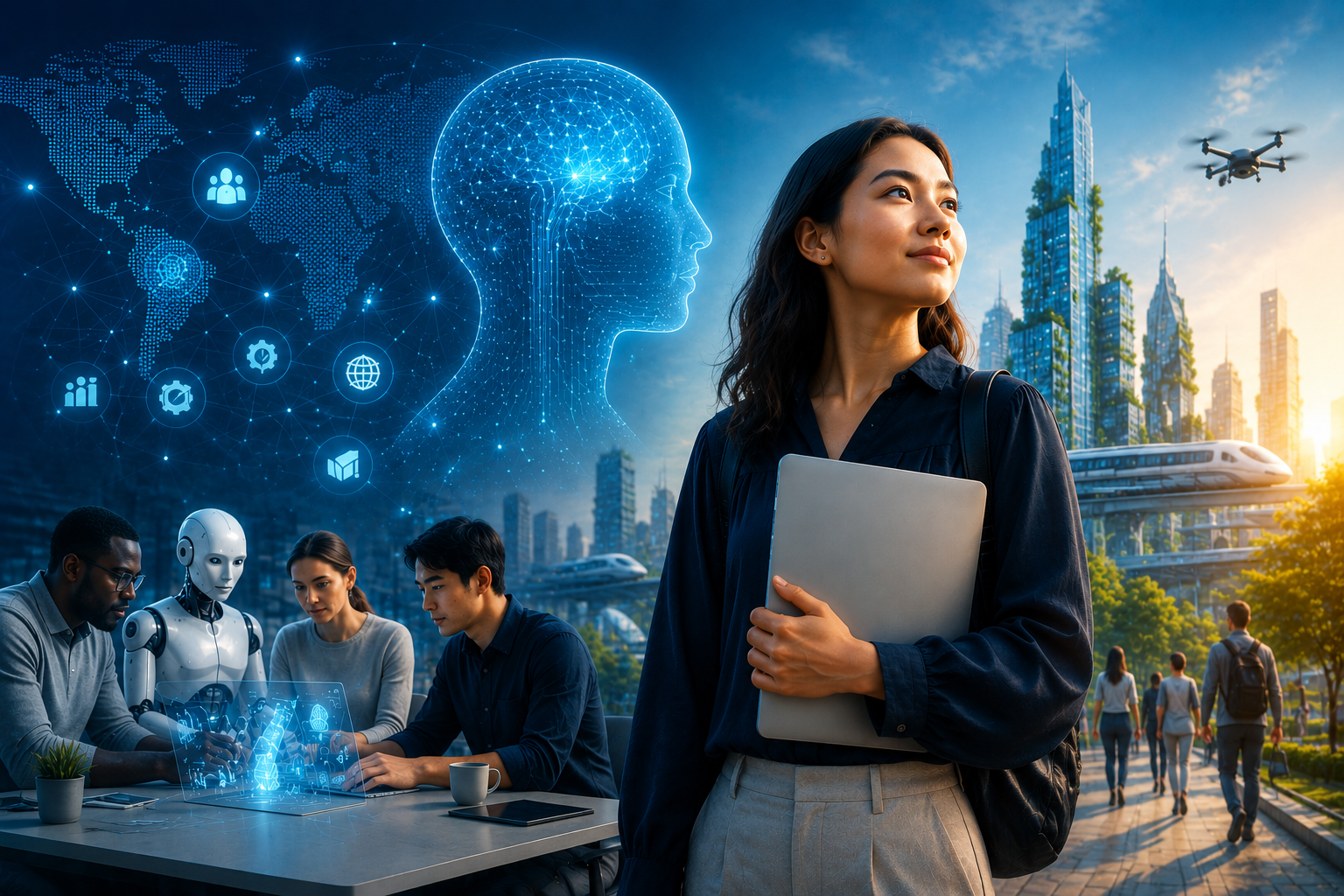

A major transformation is unfolding across the global labour market, and graduates are standing at the centre of it. For decades, the transition from university into the workplace followed a predictable pattern. Young graduates entered organisations through junior roles, handled routine assignments, learned from experienced professionals, and gradually climbed the corporate ladder. These early years served as the practical laboratory where competence, judgment, discipline and leadership capabilities were built.
Today, artificial intelligence is fundamentally altering that structure. Tasks that once introduced graduates to the realities of work are increasingly being automated by intelligent systems capable of generating reports, analysing data, drafting presentations, writing code, preparing legal summaries, automating customer support and even producing strategic insights within seconds. Activities that once consumed days now take minutes. Entry-level functions across consulting, banking, marketing, law, accounting, media, software engineering and administration are rapidly being redesigned.
This shift has created anxiety among graduates, employers and policymakers. Many young professionals are asking difficult questions. If AI can perform so much beginner-level work, where will graduates gain experience? If organisations reduce junior hiring, how will future leaders emerge? If machines increasingly handle routine tasks, what exactly becomes the value of human workers?
I am fully persuaded that beneath these concerns lies a powerful opportunity. The future does not belong to those who compete against AI. It belongs to those who understand how to work intelligently with it. The graduates who will thrive in the coming decade will not merely be degree holders; they will be individuals who combine technological fluency with human judgment, strategic thinking, ethical reasoning, creativity and adaptability.
This is why AI fluency is no longer optional. It is becoming as essential as digital literacy once became in the internet age.
Some recent global studies increasingly support this reality. The World Economic Forum reports that AI and automation are significantly reshaping workplace structures and skill demands across industries. At the same time, employers are increasingly prioritising graduates who can apply AI tools productively while still exercising independent thinking and decision-making.
The challenge before governments, universities, employers and graduates is therefore not simply about surviving technological disruption. It is about redesigning education, employability and workforce development for an AI-powered economy.
The Collapse of the Traditional Entry-Level Model
For many years, organisations relied on a hierarchical development structure. Junior employees handled repetitive assignments while senior professionals focused on strategic responsibilities. Through this process, graduates acquired technical knowledge, workplace discipline and organisational understanding.
Let’s examine some familiar examples. A young lawyer learned by reviewing documents and conducting preliminary research. A marketing graduate developed competence by preparing campaign drafts and social media content. Junior accountants learned through reconciliations and financial reporting. Analysts in consulting firms spent countless hours preparing slides, conducting research and interpreting datasets.
Although these responsibilities were often repetitive, they were foundational. They helped young professionals understand quality standards, client expectations, organisational culture and decision-making processes.
Furthermore, artificial intelligence is now reshaping this learning layer of the workforce. Generative AI systems can draft legal documents, create financial summaries, produce software code, analyse large datasets and generate business presentations almost instantly. Customer service chatbots can respond to thousands of inquiries simultaneously. AI copilots increasingly assist professionals in writing reports, managing schedules and producing strategic recommendations.
A body of research increasingly suggests that this technological transition is already affecting graduate hiring patterns. A Stanford-linked study found evidence that AI adoption has contributed to declines in employment opportunities for younger workers in AI-exposed occupations.
Another study reported that large technology firms reduced graduate hiring significantly while increasing recruitment for experienced professionals who could supervise and optimise AI-enabled systems.
This does not necessarily mean graduate jobs are disappearing entirely. Rather, the nature of entry-level work is changing dramatically.
The modern graduate is no longer expected to merely create the first draft of work. Increasingly, the graduate’s role is to refine, evaluate, interpret and improve machine-generated outputs.
This distinction is critically important. AI may produce information rapidly, but it cannot independently determine organisational priorities, understand complex human emotions, navigate sensitive negotiations or fully appreciate contextual realities unique to industries, cultures and institutions. Human oversight remains essential.
The new workplace therefore demands graduates who can combine machine efficiency with human intelligence.
AI Fluency Is Becoming a Core Employability Skill
In previous decades, graduates who understood spreadsheets, email systems and internet research gained competitive advantages. Today, AI literacy is becoming the next baseline competency.
Most employers today increasingly expect young professionals to understand how AI tools function within their industries. This expectation goes beyond simply using popular AI applications casually. Organisations are looking for graduates who can apply AI meaningfully to improve productivity, innovation, communication and problem-solving.
According to recent workforce reports, employers are increasingly treating AI capabilities as a foundational professional skill rather than a specialised technical advantage.
However, there is a major misunderstanding among many graduates. You see, knowing the names of AI platforms is not enough. Merely experimenting with chatbots or generating random prompts does not create employability value. Organisations are searching for individuals who can integrate AI into real workplace outcomes.
A graduate who can demonstrate how AI was used to improve customer engagement, analyse market trends, optimise workflow systems, develop strategic insights or streamline business operations becomes significantly more valuable than one who merely claims familiarity with AI tools.
This is where practical fluency becomes essential. AI fluency involves understanding how to frame intelligent questions, evaluate AI-generated responses, identify inaccuracies, improve outputs, apply contextual judgment and combine machine-generated insights with human reasoning.
The graduate of the future must become an “AI-enabled professional,” not simply an “AI user.” This distinction matters enormously because AI systems are not truly intelligent in the human sense. They generate outputs based on patterns, probabilities and existing data structures. They do not possess independent wisdom, ethical sensitivity, emotional understanding or organisational accountability.
The responsibility for quality, integrity and consequences still belongs to humans.
Why Human Judgment Is Becoming More Valuable
One of the greatest misconceptions surrounding AI is the assumption that accurate-looking outputs automatically equal reliable intelligence.
In reality, AI systems can produce confident but misleading answers. They may misinterpret context, reflect bias, fabricate information or generate recommendations that appear sophisticated while lacking practical relevance.
This is why human judgment is rapidly becoming one of the most valuable professional skills in the AI era.
Graduates entering the workforce must learn to question machine-generated information critically. They must ask deeper questions.
What assumptions shaped this output? What contextual information may be missing? Is the recommendation ethically sound? Does the conclusion align with organisational realities?Could the output create reputational, legal or operational risks?
These questions separate valuable professionals from passive technology users.
A junior business analyst, for example, may use AI to generate predictive trends from datasets. Yet the true value lies in determining whether the data itself is reliable, whether the patterns are commercially meaningful and whether the recommendations align with strategic priorities.
Similarly, a communications graduate may use AI to draft campaign content within seconds. But brand reputation still depends on human sensitivity, creativity, cultural awareness and ethical judgment.
In law, healthcare, finance and governance, these human capabilities become even more critical because errors can carry severe consequences.
As AI systems become more accessible, technical competence alone will no longer guarantee differentiation. Human qualities such as critical thinking, emotional intelligence, ethical reasoning, adaptability, creativity and strategic judgment will increasingly determine professional value. Ironically, the rise of AI may make deeply human capabilities even more important.
The Danger of Overdependence on AI
While AI offers remarkable productivity advantages, there is a growing risk that graduates may become overly dependent on automated systems without developing genuine expertise. This presents a serious long-term problem.
A graduate who uses AI to write reports without understanding the underlying concepts may complete assignments faster but fail to develop analytical competence. A software developer who blindly accepts AI-generated code without reviewing its logic may become operationally weak. A researcher who relies entirely on AI summaries without reading source materials risks intellectual shallowness.
Technology can accelerate learning, but it cannot replace disciplined intellectual development.
This concern is becoming increasingly relevant within universities and professional training environments. Educators globally are debating how to preserve independent thinking and problem-solving capabilities while still embracing AI-assisted learning.
The danger is not AI itself. The danger is intellectual laziness. Graduates must therefore use AI as an assistant, collaborator and productivity enhancer—not as a substitute for thinking.
The professionals who will dominate future industries are not those who surrender their judgment to machines. They are those who strengthen their capabilities through intelligent collaboration with technology.
The Leadership Pipeline Risk Facing Organisations
Another overlooked consequence of AI-driven automation is its potential impact on organisational leadership development.
Historically, junior roles served as training grounds where future executives developed operational understanding, industry exposure and managerial maturity. If organisations aggressively eliminate graduate-level opportunities in pursuit of short-term efficiency, they may unintentionally weaken their future leadership pipeline.
Today’s entry-level employees become tomorrow’s managers, directors and executives.
A company that removes foundational learning opportunities may eventually face shortages of experienced leaders who truly understand the organisation’s operational realities.
Several labour analysts and industry observers now warn that the erosion of graduate entry pathways could disrupt the traditional career ladder itself.
Forward-thinking organisations are therefore beginning to redesign graduate programs rather than eliminate them entirely.
Instead of assigning repetitive administrative work, leading firms are increasingly exposing graduates to higher-level problem-solving earlier in their careers. AI handles routine processes while graduates focus on interpretation, innovation, customer engagement and strategic support functions. This represents a smarter organisational model.
The future workforce will likely involve humans and AI systems operating collaboratively, with human workers concentrating on creativity, supervision, ethics, strategic judgment and relationship management.
Universities Must Rethink Graduate Preparation
The implications for higher education are profound. Many universities still operate with curricula designed for industrial-era workforce structures. Yet the labour market is evolving faster than academic systems in many parts of the world.
This disconnect is becoming increasingly visible. Recent employability studies show growing concern among graduates regarding their readiness for modern workplace realities.
Universities can no longer focus solely on theoretical instruction while ignoring technological transformation. Graduates require multidisciplinary preparation that combines domain expertise with digital literacy, AI fluency, critical thinking, entrepreneurship, communication and adaptability.
The future graduate must be prepared not simply for one fixed profession, but for continuous learning across evolving industries.
This is particularly important for emerging economies such as Nigeria and many African nations where youthful populations represent enormous demographic opportunities. Without deliberate investment in AI literacy and workforce reskilling, millions of graduates risk becoming disconnected from global economic competitiveness.
Governments, universities and private sector institutions must therefore collaborate urgently to redesign graduate development ecosystems.
This includes investment in AI laboratories, digital learning infrastructure, innovation hubs, industry partnerships, practical certification programs and experiential learning opportunities.
The goal should not merely be producing graduates. The goal should be producing adaptable, future-ready professionals.
Africa’s Opportunity in the AI Economy
While much discussion about AI focuses on disruption, Africa also possesses significant opportunities within the emerging digital economy.
The continent has one of the youngest populations globally. This demographic reality can become either a developmental crisis or a strategic advantage depending on how governments and institutions respond.
Young Africans are highly adaptive to technology. Across sectors such as fintech, digital media, e-commerce, agritech and software development, African innovators are already demonstrating remarkable creativity.
If properly equipped with AI capabilities, this generation could become globally competitive participants in digital transformation.
However, this requires intentional national strategies. AI education cannot remain restricted to elite institutions or technology specialists. AI literacy must become mainstream workforce preparation integrated across disciplines including business, healthcare, law, governance, agriculture, media and entrepreneurship.
Nations that move aggressively to build AI-capable human capital will likely attract greater investment, improve productivity and strengthen economic resilience.
The future global economy will increasingly reward countries that combine technological infrastructure with adaptable talent ecosystems.
The Future Belongs to Human-AI Collaboration
The debate should therefore not centre on whether AI will replace humans entirely. The more relevant question is this: which humans will remain valuable in an AI-powered economy?
The answer is increasingly clear. The professionals who thrive will be those who understand technology while preserving distinctly human strengths. They will combine technical awareness with ethical reasoning, creativity, communication, empathy, leadership and strategic thinking.
AI can process information rapidly, but it does not possess wisdom. It cannot independently define organisational purpose, understand human aspiration or inspire collective action. Human beings still provide meaning, vision, trust and accountability.
Graduates entering the workforce today must therefore embrace what may be called disciplined technological optimism. Fear alone will not prepare them for the future. Blind enthusiasm will not protect them either. What is required is intelligent adaptation.
Young professionals must learn how AI works practically within their industries. They must understand business models, customer expectations and organisational dynamics. They must become excellent communicators, strong problem-solvers and independent thinkers capable of supervising intelligent systems responsibly.
In many ways, the future graduate is becoming a hybrid professional, someone who combines digital intelligence with human judgment.
In conclusion, Artificial intelligence is not merely introducing new software tools into the workplace. It is fundamentally redefining employability, organisational structures and the future of professional development.
The traditional entry-level career pathway is evolving rapidly. Routine assignments that once trained young professionals are increasingly being automated, forcing organisations, universities and governments to rethink how graduates acquire workplace competence.
Yet this transformation should not be viewed only as a threat. It also represents one of the greatest opportunities for workforce reinvention in modern history.
Graduates who develop AI fluency, critical thinking, adaptability and strategic judgment will possess significant advantages in the evolving economy. Organisations that redesign graduate development around human-AI collaboration will build stronger innovation cultures and future leadership pipelines. Nations that invest in AI literacy and digital workforce transformation will position themselves more competitively within the global economy.
I will discuss extensively the necessary skills that graduates of 2026 will required to build a thriving career in era of AI in the second part of this article.
Let’s have this clarity: The future of work will not belong exclusively to machines. Neither will it belong to humans who resist technological change. It will belong to those who can intelligently combine both worlds, which we called human intelligence-Ai loop or collaboration (HI-AI).
Artificial intelligence may generate the first draft of the future, but humanity will still determine its direction, values and impact.
Prof. Sarumi, a digital transformation architect and leadership strategist with over 40 years of cross-sector experience across Nigeria and the African continent, writes from Lagos