
[]
Home response.text()) .then(data => new DOMParser().parseFromString(data, “text/html”)) .then(dom => dom.querySelector(“div.uos-sitemap”)) .then(sitemap => getBreadcrumbsFromSitemap(sitemap)) .catch(() => getBreadcrumbsFromPath()) .then(breadcrumbs => buildBreadcrumbsHtml(breadcrumbs)) function findElementToStartFrom(sitemap) { let element = sitemap.querySelector(“a[href='” + windowPath + “?’]”) || sitemap.querySelector(“a[href='” + windowPath + “‘]”) if (element) { return element } let pathParts = windowPath.split(“/”).filter(part => part !== ”) for(let i = pathParts.length; i >=1 ; i–) { let path = (‘/’ + pathParts.slice(0, i).join(‘/’)) let element = sitemap.querySelector(“a[href='” + path + “‘]”) || sitemap.querySelector(“a[href='” + path + “/index.page’]”) || sitemap.querySelector(“a[href='” + path + “?’]”) || sitemap.querySelector(“a[href='” + path + “/index.page?’]”) if (element) { return element } } throw new Error(“Can’t find starting element in sitemap”) } function getBreadcrumbsFromSitemap(sitemap) { let breadcrumbs = [] let element = findElementToStartFrom(sitemap); while (element) { breadcrumbs.push(makeBreadcrumb((new URL(element.href)).pathname, element.innerText.trim())) element = getParentLink(element) } let homeTitle = sitemap.querySelector(“h2”).innerText.trim() let homeUrl = sitemap.querySelector(“a”).href.trim() breadcrumbs.push(makeBreadcrumb((new URL(homeUrl).pathname), homeTitle)) return breadcrumbs.reverse() } function getBreadcrumbsFromPath() { console.log(“Building breadcrumbs from path”) let breadcrumbs = [] let pathParts = windowPath.split(“/”).filter(part => part !== ”) for(let i = 1; i char.toUpperCase()) breadcrumbs.push(makeBreadcrumb(url, title)) } return breadcrumbs } function makeBreadcrumb(url, name) { return {href: url.trim(), name: name.trim()} } function buildBreadcrumbsHtml(breadcrumbs) { let rootElement = document.querySelector(“#BreadcrumbListNavElem”) breadcrumbs.forEach(crumb => { if (crumb.href === windowPath) { return } let rootDiv = document.createElement(“div”) rootDiv.setAttribute(“typeof”, “ListItem”) rootDiv.setAttribute(“property”, “itemListElement”) rootDiv.setAttribute(“class”, “uos-breadcrumb-child”) let link = document.createElement(“a”) link.href = crumb.href link.setAttribute(“title”, crumb.name) link.setAttribute(“typeOf”, “WebPage”) link.setAttribute(“property”, “item”) let titleSpan = document.createElement(“span”) titleSpan.innerText = crumb.name rootDiv.appendChild(link) link.appendChild(titleSpan) rootElement.innerHTML += “>” rootElement.appendChild(rootDiv) }) } function getParentLink(element) { while (element.tagName !== “UL”) { element = element.parentElement if (!element) { return null } } return Array.from(element.parentElement.children).find(item => item.tagName === “A”) } ]]>
Published: 2024-07-18 09:41:00
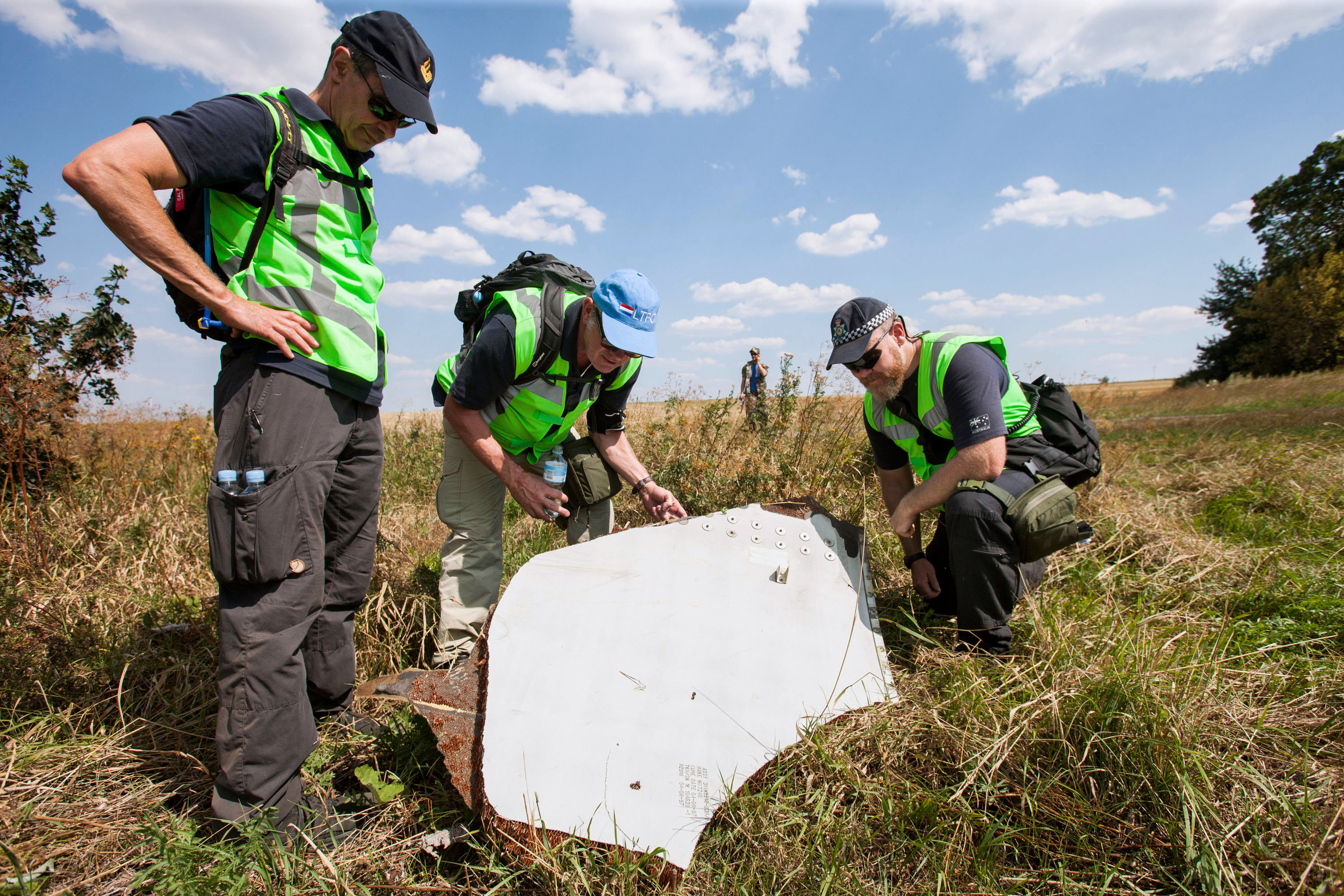 Investigation of the crash site of MH17. Image courtesy of the Ministerie van Defensie, CC0, via Wikimedia Commons.
On the 10th anniversary of the devastating shooting down of Malaysian Airlines Flight 17, aviation safety experts from the University of Southampton have developed AI to calculate the risk of planes being shot down with greater accuracy than ever before.
Highlighting the huge global discrepancies and the bias in current methods of calculating risks associated with flying over conflict zones, academics from the university’s Department of Decision Analytics and Risk, in the Centre for Risk Research, have developed algorithms that use artificial intelligence to predict the likelihood of a shoot-down.
They are collaborating with world-leading aviation security and risk management company Osprey Flight Solutions to encourage adoption of their AI by global aviation companies.
Their work coincides with the 10th anniversary of MH17, one of the world’s most notorious and devastating aircraft shootings. In July 2014, all 298 passengers and crew were killed when flight MH17, en route from Amsterdam to Kuala Lumpur, was shot down by Russian-controlled forces over Ukraine.
Mario Brito , Professor of Risk Analysis and Risk Management, and PhD student Stanislav Bukhman are behind the AI solution to predicting aviation risk.
Professor Brito said: “Current methods for calculating risk associated with flying over conflict zones are based on matrices that rely on the expertise of those using them – and are subject to bias. Using AI would significantly enhance aviation safety. The method we have developed is easy to use, apply and understand.”
The AI works by learning from past aviation security events to assess the relationship between overflight security events, conflict characteristics, and geopolitical factors. It can quantify the overflight risk for different operation scenarios and conflict types, enabling civil airliners to make risk-informed judgments about flight routes.
Professor Brito added: “With an increase in the armour capability, and an increase in conflict, the safe airspace through which civil airliners can navigate is shrinking. The current standards do not provide means to quantify the risk of civil aircraft shoot down.”
The airline industry transports billions of people around the world every year. In 2022, there were 2.3 billion passenger journeys. A number of conflict zones in the world makes route planning, especially for long-haul flights, very complex.
The Aviation Safety Network has records of more than 300 cases of civil aircraft shot down between 1946 and 2022. As well as high profile cases such as MH17, these include the shooting down of an aircraft carrying military supplies in May 2020 due to misidentification by the Ethiopian military; a passenger plane shot down during military exercises over the Black Sea in 2001; and a cargo plane hit by a missile shortly after departure from Baghdad airport in 2003.
Andrew Nicholson, CEO Osprey Flight Solutions, said: “Distressingly, we have seen a misidentification and shoot down incident involving a civilian aircraft about once every six years on average. On top of this, there are other risks from drones and missiles, and there are many near-misses. So, the subject of aviation safety is a concern for everyone who gets in an aircraft, and it is absolutely critical that we can calculate risks to the best of our ability.”
He added: “Several governments around the world, for example, have historically prohibited flights over Afghanistan, during periods when there was no risk of the plane being shot down. But this has forced aircraft to operate in other areas where, perhaps, they are at much greater risk of a catastrophic mis-identification incident. Politics conflicting with safety is a real issue. Every country has a different method of assessing the risk.”