

[]
Home response.text()) .then(data => new DOMParser().parseFromString(data, “text/html”)) .then(dom => dom.querySelector(“div.uos-sitemap”)) .then(sitemap => getBreadcrumbsFromSitemap(sitemap)) .catch(() => getBreadcrumbsFromPath()) .then(breadcrumbs => buildBreadcrumbsHtml(breadcrumbs)) function findElementToStartFrom(sitemap) { let element = sitemap.querySelector(“a[href='” + windowPath + “?’]”) || sitemap.querySelector(“a[href='” + windowPath + “‘]”) if (element) { return element } let pathParts = windowPath.split(“/”).filter(part => part !== ”) for(let i = pathParts.length; i >=1 ; i–) { let path = (‘/’ + pathParts.slice(0, i).join(‘/’)) let element = sitemap.querySelector(“a[href='” + path + “‘]”) || sitemap.querySelector(“a[href='” + path + “/index.page’]”) || sitemap.querySelector(“a[href='” + path + “?’]”) || sitemap.querySelector(“a[href='” + path + “/index.page?’]”) if (element) { return element } } throw new Error(“Can’t find starting element in sitemap”) } function getBreadcrumbsFromSitemap(sitemap) { let breadcrumbs = [] let element = findElementToStartFrom(sitemap); while (element) { breadcrumbs.push(makeBreadcrumb((new URL(element.href)).pathname, element.innerText.trim())) element = getParentLink(element) } let homeTitle = sitemap.querySelector(“h2”).innerText.trim() let homeUrl = sitemap.querySelector(“a”).href.trim() breadcrumbs.push(makeBreadcrumb((new URL(homeUrl).pathname), homeTitle)) return breadcrumbs.reverse() } function getBreadcrumbsFromPath() { console.log(“Building breadcrumbs from path”) let breadcrumbs = [] let pathParts = windowPath.split(“/”).filter(part => part !== ”) for(let i = 1; i char.toUpperCase()) breadcrumbs.push(makeBreadcrumb(url, title)) } return breadcrumbs } function makeBreadcrumb(url, name) { return {href: url.trim(), name: name.trim()} } function buildBreadcrumbsHtml(breadcrumbs) { let rootElement = document.querySelector(“#BreadcrumbListNavElem”) breadcrumbs.forEach(crumb => { if (crumb.href === windowPath) { return } let rootDiv = document.createElement(“div”) rootDiv.setAttribute(“typeof”, “ListItem”) rootDiv.setAttribute(“property”, “itemListElement”) rootDiv.setAttribute(“class”, “uos-breadcrumb-child”) let link = document.createElement(“a”) link.href = crumb.href link.setAttribute(“title”, crumb.name) link.setAttribute(“typeOf”, “WebPage”) link.setAttribute(“property”, “item”) let titleSpan = document.createElement(“span”) titleSpan.innerText = crumb.name rootDiv.appendChild(link) link.appendChild(titleSpan) rootElement.innerHTML += “>” rootElement.appendChild(rootDiv) }) } function getParentLink(element) { while (element.tagName !== “UL”) { element = element.parentElement if (!element) { return null } } return Array.from(element.parentElement.children).find(item => item.tagName === “A”) } ]]>
Published: 2025-04-25 09:09:00
 The University of Southampton contingent at the launch of the Framing the Future report. Credit: Matt Crossick
The University of Southampton has played a key role in a new national report into the value and importance of visual arts.
The report, called Framing the Future: The Political Case for Strengthening the Visual Arts Ecosystem, was launched at the House of Commons.
It was commissioned by the University’s John Hansard Gallery and Southampton Institute for Arts and Humanities, alongside the Contemporary Visual Arts Network (CVAN) , in collaboration with a-n The Artists Information Company , the Design and Artists Copyright Society (DACS) , and Plus Tate .
The report outlines four recommendations to safeguard and invest in the UK’s visual arts and artists ahead of the UK Government Spending Review, expected to conclude in June.
The recommendations for the UK Spending Review are:
- Establish a UK Cultural Investment Partnership Fund for emergency support, business innovation and matched capital investment
- Create a £5 million Grassroots Visual Arts Fund for small galleries, studios and artist-led spaces
- Expand access to creative education by investing £8.4 million in the National Saturday Club network, providing free creative education to 54,000 young people
- Restore specialist subject funding in higher education , reversing 2021 cuts to secure the future of high-quality creative courses.
Professor Jane Falkingham, Vice President Engagement and International at the University of Southampton, said: “The University plays a major, forward-thinking role in supporting arts and culture through its civic and global engagement activities. We coordinate the Culture and Creativity Policy Network, which brings together expertise in creative approaches to cultural policy research.
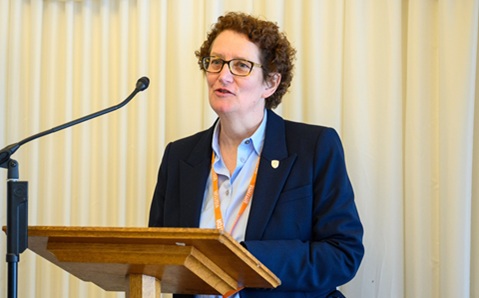 Professor Jane Falkingham speaking at the launch. Credit: Matt Crossick
“Together with our Southampton Institute for Arts and Humanities, our Winchester School of Art, and the John Hansard Gallery, the University places art and design at the forefront of tackling contemporary challenges, education, research, and the community.
“We are proud to be a key partner in this new report, a once-in-a-generation intervention that outlines crucial investment for the future.”
The UK is the second largest visual art market in the world and, in 2023, UK visual art exports totalled more than £4.1 billion. The UK is also home to 12 of the world’s 100 most visited museums and galleries.
Despite these strengths, the country’s arts sector is under strain with challenges including trade restrictions post-Brexit, emerging technologies like AI, limited support, and an increasingly precarious infrastructure of studios and galleries.
Woodrow Kernohan, Director of John Hansard Gallery, said: “This report shows how the visual arts deliver real economic and social value nationwide. Our position within the University of Southampton enables much of what we do, but public investment through Arts Council England remains vital to our future – and to the creative education of current and future generations.”
Read the full Framing the Future report .