

[]
Home response.text()) .then(data => new DOMParser().parseFromString(data, “text/html”)) .then(dom => dom.querySelector(“div.uos-sitemap”)) .then(sitemap => getBreadcrumbsFromSitemap(sitemap)) .catch(() => getBreadcrumbsFromPath()) .then(breadcrumbs => buildBreadcrumbsHtml(breadcrumbs)) function findElementToStartFrom(sitemap) { let element = sitemap.querySelector(“a[href='” + windowPath + “?’]”) || sitemap.querySelector(“a[href='” + windowPath + “‘]”) if (element) { return element } let pathParts = windowPath.split(“/”).filter(part => part !== ”) for(let i = pathParts.length; i >=1 ; i–) { let path = (‘/’ + pathParts.slice(0, i).join(‘/’)) let element = sitemap.querySelector(“a[href='” + path + “‘]”) || sitemap.querySelector(“a[href='” + path + “/index.page’]”) || sitemap.querySelector(“a[href='” + path + “?’]”) || sitemap.querySelector(“a[href='” + path + “/index.page?’]”) if (element) { return element } } throw new Error(“Can’t find starting element in sitemap”) } function getBreadcrumbsFromSitemap(sitemap) { let breadcrumbs = [] let element = findElementToStartFrom(sitemap); while (element) { breadcrumbs.push(makeBreadcrumb((new URL(element.href)).pathname, element.innerText.trim())) element = getParentLink(element) } let homeTitle = sitemap.querySelector(“h2”).innerText.trim() let homeUrl = sitemap.querySelector(“a”).href.trim() breadcrumbs.push(makeBreadcrumb((new URL(homeUrl).pathname), homeTitle)) return breadcrumbs.reverse() } function getBreadcrumbsFromPath() { console.log(“Building breadcrumbs from path”) let breadcrumbs = [] let pathParts = windowPath.split(“/”).filter(part => part !== ”) for(let i = 1; i char.toUpperCase()) breadcrumbs.push(makeBreadcrumb(url, title)) } return breadcrumbs } function makeBreadcrumb(url, name) { return {href: url.trim(), name: name.trim()} } function buildBreadcrumbsHtml(breadcrumbs) { let rootElement = document.querySelector(“#BreadcrumbListNavElem”) breadcrumbs.forEach(crumb => { if (crumb.href === windowPath) { return } let rootDiv = document.createElement(“div”) rootDiv.setAttribute(“typeof”, “ListItem”) rootDiv.setAttribute(“property”, “itemListElement”) rootDiv.setAttribute(“class”, “uos-breadcrumb-child”) let link = document.createElement(“a”) link.href = crumb.href link.setAttribute(“title”, crumb.name) link.setAttribute(“typeOf”, “WebPage”) link.setAttribute(“property”, “item”) let titleSpan = document.createElement(“span”) titleSpan.innerText = crumb.name rootDiv.appendChild(link) link.appendChild(titleSpan) rootElement.innerHTML += “>” rootElement.appendChild(rootDiv) }) } function getParentLink(element) { while (element.tagName !== “UL”) { element = element.parentElement if (!element) { return null } } return Array.from(element.parentElement.children).find(item => item.tagName === “A”) } ]]>
Published: 2025-02-19 09:55:00
 From left: Wendy Appleby (Vice-President, Operations, University of Southampton), Miguel Mera (Dean of the Faculty of Arts and Humanities, University of Southampton), Rachel Pistol (Director of EHRI-UK) and Neil Gregor (Director of the Parkes Institute) at the launch of EHRI-UK
A new national hub that will safeguard and advance international collaboration and research on the Holocaust is being co-led by the University of Southampton.
The first major project for the hub – which is called the European Holocaust Research Infrastructure (EHRI-UK) – will be to digitally map all collections in the UK that relate to the Holocaust.
Dr Rachel Pistol , Director of EHRI-UK and Digital Historian at the University of Southampton, said: “The UK is home to an enormously rich collection of records relating to the Holocaust and refugees who fled Nazi oppression. These sit in archives, museums and private collections – and some we know very little about.
“This first project for EHRI-UK will bring all of these records together digitally for the first time, helping researchers to access them and undoubtedly bettering our understanding and learnings from that period in history, as well as helping to counter Holocaust denial and antisemitism.”
EKRI-UK will also fund transnational research fellowships and placements, connect researchers, and bring together experiences and memories of the Holocaust from different countries.
Through co-leading EHRI-UK, the University of Southampton is linked to a large international network of research institutes, archives, museums and academic institutions.
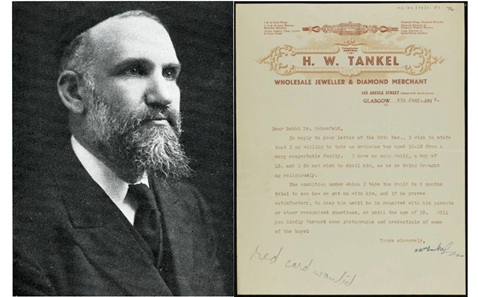 Portrait of Rabbi Dr Solomon Schonfeld, from the Parkes Collections [ref MS183/1013/2], and letter from H.W. Tankel, a jeweller and diamond merchant from Glasgow, to Rabbi Dr Schonfeld stating his wish to care for an “orthodox boy” until he can be reunited with his parents, or reaches 18 years of age. Parkes Collections [ref MS183/53/2/f1]
The university is home to The Parkes Institute , a world-renowned centre of Jewish studies, and the Parkes Collections , which contain key documents, including the unique records of Rabbi Dr Solomon Schonfeld, Executive Director of the Chief Rabbi’s Religious Emergency Council, who played a vital role in rescuing Jews from Nazi oppression and on Kindertransports.
EHRI-UK is funded by the Arts and Humanities Research Council (AHRC). Endorsing its launch, Professor Christopher Smith, Executive Chair of the AHRC, said: “It is an obligation of the highest seriousness for us to preserve and share the memory of the Holocaust, a critical turning point in our history and a near-unimaginable tragedy.
“This infrastructure is a key mechanism that brings the fragile and scattered records into the digital world, to preserve it for the future. I am proud that AHRC has supported the UK’s presence in a powerful European consortium.”
While the UK branch is new, EHRI was established in 2010 as a collaboration of archives and research institutions spanning 17 countries in Europe, Israel and the US, supporting transnational Holocaust research.
EHRI has just become the 30th EU-recognised research consortium, a legal standing that signifies its importance and permanence. Last month, government ministers from 10 countries gathered to sign the EHRI-ERIC into being in Warsaw. It was granted the legal status of a European Research Infrastructure Consortium (ERIC) .