
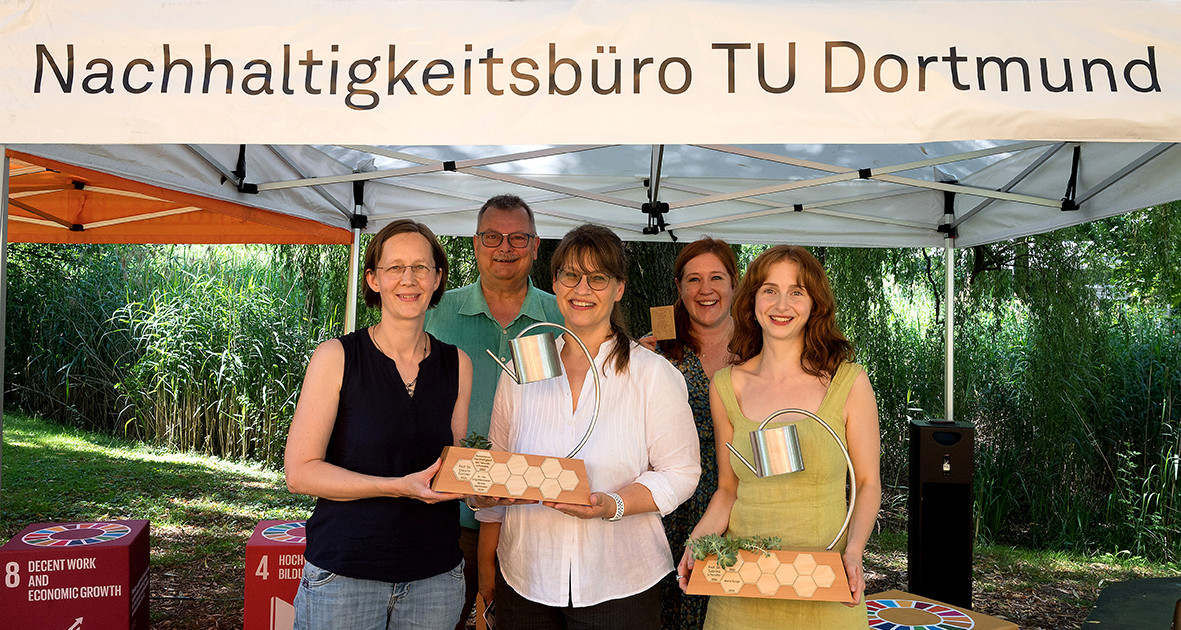
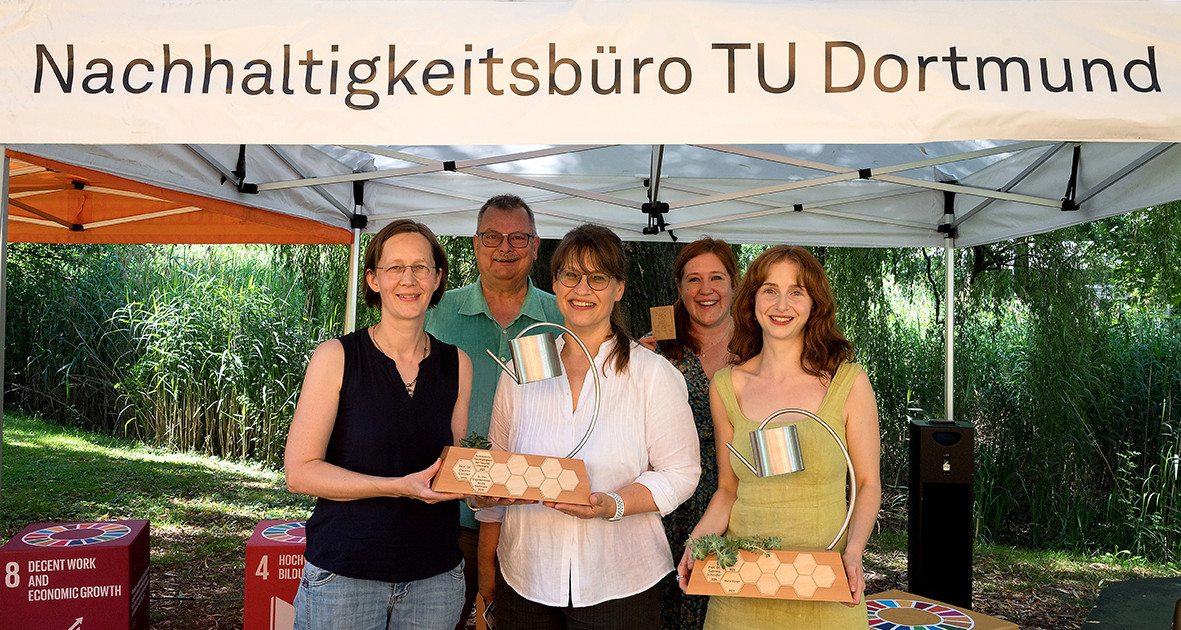
The Sustainability Office of TU Dortmund University and the Corporate Social Responsibility (CSR) Office of FH Dortmund jointly established the Impact Cup in 2024. “The Impact Cup is far more than a symbolic honor,” says Dr. Henning Moldenhauer, Head of the Sustainability Office. “It makes the sustainable commitment of our university’s members visible and demonstrates that ideas and projects continually emerge from within the university itself. At the same time, the award strengthens the exchange and sense of community among our university members and creates space for new collaborations.”
The roving trophies for the award were designed and built by apprentices of Technical Product Design at TU Dortmund University: a floating metal watering can above a small green seedling symbolizes sustainability, which is meant to grow continually through collective nurturing.
The Award Recipients
Professor Gerhard Schembecker, Vice President Finance, presented this year’s Impact Cup to Dr. Ute Engelkenmeier of the University Library and Nicole Rechmann of the IT and Media Center (ITMC). The two have been involved in the setting up of the “Seed Library”: since 2022, members of TU Dortmund University have been able to take seeds from an exchange box in the library free of charge and return the seeds they later harvest. Through this initiative, the project aims to help preserve varietal diversity and foster knowledge about home vegetable cultivation in a low-threshold manner. The jury noted that Dr. Engelkenmeier had advocated for the exchange box and a dedicated sustainability section in the library even before the concept was established and widely known. Rechmann has supported the project from the outset on a voluntary basis by sharing her knowledge and donating seeds to ensure an ecologically valuable and growing inventory, particularly during the set-up phase.
On behalf of FH Dortmund, Chancellor Svenja Stepper presented the Impact Cup to Marie Runge. As Sustainability Officer of the General Students’ Committee (AStA) of the university of applied sciences, the master’s student has championed a variety of projects – for example, a “Fairteiler” food-sharing cabinet to prevent food from being thrown away, and the Campus Life Working Group, which connects stakeholders from both universities. In addition, Runge supports the CSR research project “GRUND:KLIMA” as a student research assistant, working to make the City of Dortmund’s climate funding programs more socially equitable. The jury highlighted that her commitment served as a role model for students showing how they can actively help shape their university.
Installation and Panel Discussion on Mobility
The award ceremony took place at the close of Sustainability Week, which is jointly organized by the General Student Committees (AStAs) and sustainability offices of both universities as well as the Studierendenwerk Dortmund (Association for Student Affairs). This year, the accompanying program was devoted to the theme of “Mobility on the Dortmund Campus.”
University members were invited to visit the installation “Haltestelle Zukunft” (Bus Stop of the Future): the student organizers had transformed the section next to the bus stop beneath the Mensa Bridge into a car-free social space for two days, with seating, creative projects, and planting boxes. On 25 June, representatives of the City of Dortmund were on site to ask university members and campus visitors about their long-term wishes for the area and for mobility in Dortmund. Following the award ceremony, students, researchers, and technical and administrative staff of both universities also took part in a Fish Bowl discussion, in which the audience was invited to contribute questions and comments of their own.