
[]
Home response.text()) .then(data => new DOMParser().parseFromString(data, “text/html”)) .then(dom => dom.querySelector(“div.uos-sitemap”)) .then(sitemap => getBreadcrumbsFromSitemap(sitemap)) .catch(() => getBreadcrumbsFromPath()) .then(breadcrumbs => buildBreadcrumbsHtml(breadcrumbs)) function findElementToStartFrom(sitemap) { let element = sitemap.querySelector(“a[href='” + windowPath + “?’]”) || sitemap.querySelector(“a[href='” + windowPath + “‘]”) if (element) { return element } let pathParts = windowPath.split(“/”).filter(part => part !== ”) for(let i = pathParts.length; i >=1 ; i–) { let path = (‘/’ + pathParts.slice(0, i).join(‘/’)) let element = sitemap.querySelector(“a[href='” + path + “‘]”) || sitemap.querySelector(“a[href='” + path + “/index.page’]”) || sitemap.querySelector(“a[href='” + path + “?’]”) || sitemap.querySelector(“a[href='” + path + “/index.page?’]”) if (element) { return element } } throw new Error(“Can’t find starting element in sitemap”) } function getBreadcrumbsFromSitemap(sitemap) { let breadcrumbs = [] let element = findElementToStartFrom(sitemap); while (element) { breadcrumbs.push(makeBreadcrumb((new URL(element.href)).pathname, element.innerText.trim())) element = getParentLink(element) } let homeTitle = sitemap.querySelector(“h2”).innerText.trim() let homeUrl = sitemap.querySelector(“a”).href.trim() breadcrumbs.push(makeBreadcrumb((new URL(homeUrl).pathname), homeTitle)) return breadcrumbs.reverse() } function getBreadcrumbsFromPath() { console.log(“Building breadcrumbs from path”) let breadcrumbs = [] let pathParts = windowPath.split(“/”).filter(part => part !== ”) for(let i = 1; i char.toUpperCase()) breadcrumbs.push(makeBreadcrumb(url, title)) } return breadcrumbs } function makeBreadcrumb(url, name) { return {href: url.trim(), name: name.trim()} } function buildBreadcrumbsHtml(breadcrumbs) { let rootElement = document.querySelector(“#BreadcrumbListNavElem”) breadcrumbs.forEach(crumb => { if (crumb.href === windowPath) { return } let rootDiv = document.createElement(“div”) rootDiv.setAttribute(“typeof”, “ListItem”) rootDiv.setAttribute(“property”, “itemListElement”) rootDiv.setAttribute(“class”, “uos-breadcrumb-child”) let link = document.createElement(“a”) link.href = crumb.href link.setAttribute(“title”, crumb.name) link.setAttribute(“typeOf”, “WebPage”) link.setAttribute(“property”, “item”) let titleSpan = document.createElement(“span”) titleSpan.innerText = crumb.name rootDiv.appendChild(link) link.appendChild(titleSpan) rootElement.innerHTML += “>” rootElement.appendChild(rootDiv) }) } function getParentLink(element) { while (element.tagName !== “UL”) { element = element.parentElement if (!element) { return null } } return Array.from(element.parentElement.children).find(item => item.tagName === “A”) } ]]>
Published: 2025-09-17 09:41:00
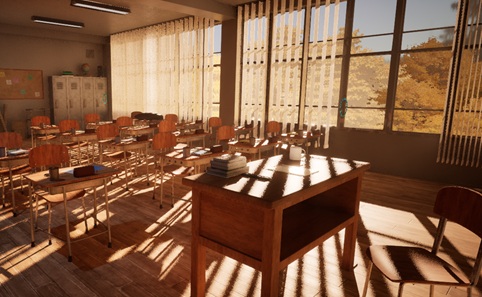
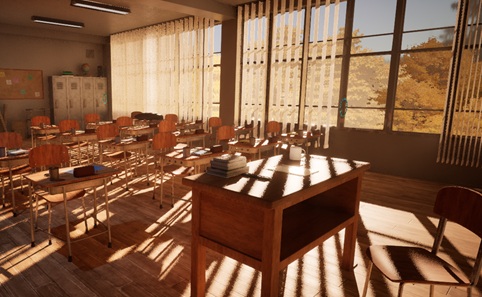 The classroom ’memory’ in Echoes of the Last Breath
Confronting a near-death experience via virtual reality, with key life moments flashing before your eyes, is one of 16 student projects from Winchester School of Art on show in London this week.
Players lie on a couch wearing a VR headset that simulates a near-death journey, taking them through snippets of life moments in locations including a classroom, a city, the countryside, a wedding, a hospital and a funeral.
The ‘memories’ appear as floating bubbles and the life journey is determined by how long players gaze at different bubbles. The experience culminates in a fleeting journey through the memories the player has engaged with.
The experience, called Echoes of the Last Breath, has been created by arts and media technology students Veronica Zhang, Yimeng Li and Xinyu Zhang.
Veronica, 26, studying a PhD in art, said: “The concept was inspired by research on near-death experiences showing they can reduce death anxiety and foster empathy. We wanted to design a short VR encounter that helps young audiences reflect on life’s meaning beyond extra lives or respawns in games. We hope it resonates with a wider audience.”
 A scene from the VR immersive garden
The project forms part of Winchester School of Art’s exhibition, called Tender Interbeing, at London Design Festival. It is the first time the school has taken part in the event.
Other projects – six of which are in collaboration with the Communication University of China – include a board game about financial planning and resilience, VR shopping, a VR experience to interact with stars in the night sky, and using artificial intelligence to support older people at home.
There is a VR immersive garden featuring plants that are threatened with extinction. Fashion management student Tiffany Chan, 24, led the project and said: “Setting our project in 2065, we imagined that technology will be in our daily lives, and we created an immersive garden to heal emotional stress.”
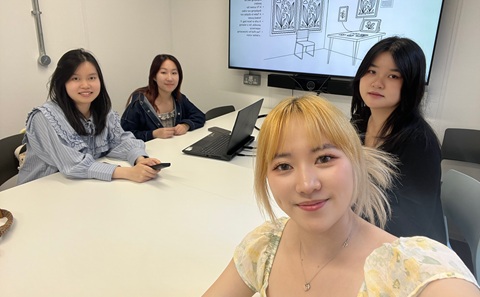 The VR immersive garden project team
Four creative computing and graphic communication students from different backgrounds have created a VR experience that brings different cultures together.
Qingzhou Cai from China, Jocelyn Eddy from England, and Lavanya Sharma and Nehi Ipplil from India have developed a collage of footage from their three homelands highlighting cultural events, geographical features and different foods.
Jocelyn, 19, said: “We wanted to explore multiculturalism and how this this could lead to a utopian future. We have portrayed aspects of our cultures, shown simultaneously in three windows.”
Yuanyuan Yin, Professor of Design, who has curated the exhibition, said: “Tender Interbeing is all about how to use technology to create an inclusive and empathetic future. The main concept is looking at the future and how humans and technology will live together in harmony.”
Professor Deborah Gill, Vice-President (Education) at the University of Southampton, said: “This exhibition is a real example of co-creation and collaborative interdisciplinary thinking, which makes the University of Southampton such a special place and shows how our students are shaping the future with us.”
Nickie Hirst, Head of the Department of Design, added: “Our first participation in the London Design Festival marks a milestone for the department, showcasing how students and academics from across institutions and nations can work together through design to address today’s pressing challenges.”
The exhibition is open from Wednesday 17 to Friday 19 September at White City Warehouse, Wood Lane, London, and admission is free. Visit the festival website for more information.