
[]
Home response.text()) .then(data => new DOMParser().parseFromString(data, “text/html”)) .then(dom => dom.querySelector(“div.uos-sitemap”)) .then(sitemap => getBreadcrumbsFromSitemap(sitemap)) .catch(() => getBreadcrumbsFromPath()) .then(breadcrumbs => buildBreadcrumbsHtml(breadcrumbs)) function findElementToStartFrom(sitemap) { let element = sitemap.querySelector(“a[href='” + windowPath + “?’]”) || sitemap.querySelector(“a[href='” + windowPath + “‘]”) if (element) { return element } let pathParts = windowPath.split(“/”).filter(part => part !== ”) for(let i = pathParts.length; i >=1 ; i–) { let path = (‘/’ + pathParts.slice(0, i).join(‘/’)) let element = sitemap.querySelector(“a[href='” + path + “‘]”) || sitemap.querySelector(“a[href='” + path + “/index.page’]”) || sitemap.querySelector(“a[href='” + path + “?’]”) || sitemap.querySelector(“a[href='” + path + “/index.page?’]”) if (element) { return element } } throw new Error(“Can’t find starting element in sitemap”) } function getBreadcrumbsFromSitemap(sitemap) { let breadcrumbs = [] let element = findElementToStartFrom(sitemap); while (element) { breadcrumbs.push(makeBreadcrumb((new URL(element.href)).pathname, element.innerText.trim())) element = getParentLink(element) } let homeTitle = sitemap.querySelector(“h2”).innerText.trim() let homeUrl = sitemap.querySelector(“a”).href.trim() breadcrumbs.push(makeBreadcrumb((new URL(homeUrl).pathname), homeTitle)) return breadcrumbs.reverse() } function getBreadcrumbsFromPath() { console.log(“Building breadcrumbs from path”) let breadcrumbs = [] let pathParts = windowPath.split(“/”).filter(part => part !== ”) for(let i = 1; i char.toUpperCase()) breadcrumbs.push(makeBreadcrumb(url, title)) } return breadcrumbs } function makeBreadcrumb(url, name) { return {href: url.trim(), name: name.trim()} } function buildBreadcrumbsHtml(breadcrumbs) { let rootElement = document.querySelector(“#BreadcrumbListNavElem”) breadcrumbs.forEach(crumb => { if (crumb.href === windowPath) { return } let rootDiv = document.createElement(“div”) rootDiv.setAttribute(“typeof”, “ListItem”) rootDiv.setAttribute(“property”, “itemListElement”) rootDiv.setAttribute(“class”, “uos-breadcrumb-child”) let link = document.createElement(“a”) link.href = crumb.href link.setAttribute(“title”, crumb.name) link.setAttribute(“typeOf”, “WebPage”) link.setAttribute(“property”, “item”) let titleSpan = document.createElement(“span”) titleSpan.innerText = crumb.name rootDiv.appendChild(link) link.appendChild(titleSpan) rootElement.innerHTML += “>” rootElement.appendChild(rootDiv) }) } function getParentLink(element) { while (element.tagName !== “UL”) { element = element.parentElement if (!element) { return null } } return Array.from(element.parentElement.children).find(item => item.tagName === “A”) } ]]>
Published: 2024-11-13 08:00:00
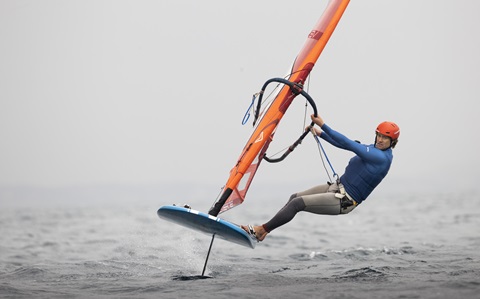
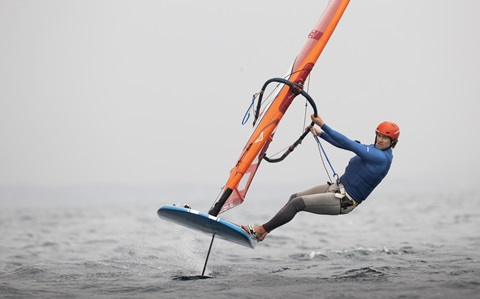 Sam Sills. Credit: Lloyd Images & British Sailing Team
Engineering students and staff from the University of Southampton have used pioneering analysis techniques and assessments to give a professional windsurfer the edge.
They have used the university’s cutting-edge towing tank and X-ray Computed Tomography (X-CT) scanning facilities to examine and test windsurfing kit belonging to Sam Sills, who represents Great Britain in windsurfing.
The work is being celebrated to mark National Engineering Day on 13 November, which is led by the Royal Academy of Engineering and aims to celebrate the UK’s engineers and how they shape the world around us.
Sam competes in iQFOiL class windsurfing, or ‘windfoiling’, where the board elevates above the water. Riders can race at speeds of up to 30 knots (56 kilometres per hour).
Tests at the university assessed the hydrofoil’s performance in water, and 3D X-CT scans analysed the overall geometry, structural integrity, and variability between foils.
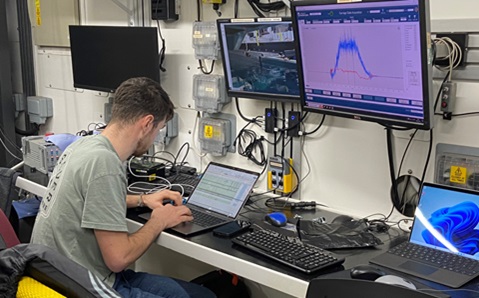 Student Jamie Cook at work on the towing tank’s platform
Dr Joe Banks , Lecturer in Maritime Engineering, supervised a third-year Maritime Engineering student project that tested the foils in the university’s 140-metre-long towing tank, which has a moving platform that can tow structures through the water at up to 10 metres per second (36kph).
Dr Banks said: “We have a long-standing relationship with the UK Sports Institute, which funds research projects here to help improve athlete performance. It’s really exciting for us to be working with Sam, and for our undergraduate students’ research to help support him, and it’s thanks to our involvement in sports research over several decades that we were connected to him.”
Student Jamie Cook, 21, measured the lift and drag forces of the foils through water at a range of speeds. Jamie said: “My favourite part of project was completing the first high speed run. It was exciting to see testing equipment work at close to 18 knots whilst also seeing the measured forces that the foils produced.”
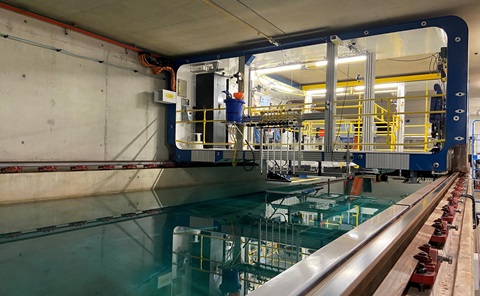 Inside the towing tank
The university’s µ-VIS X-CT Imaging Centre (part of the UK’s national research facility for X-CT), houses the two largest high-energy micro-focus X-CT systems within the UK academic sector – one of which was used to inspect the structure and make-up of four sets of foils belonging to Sam.
Sam’s coach Leo McCallin attended the scanning. He said: “All four foils are the same design from the same manufacturer, but there are discrepancies when you look closely, as it’s practically impossible to make them all absolutely identical.
“There are two potential advantages in scanning the foils like this. The scans show any voids inside the structures, which can inform us as to potential concerns around high stress regions – and hence likelihood of that part to break under load.
“Scanning them also helps us to spot any variation in the shape, which can influence how fast the foil is.”
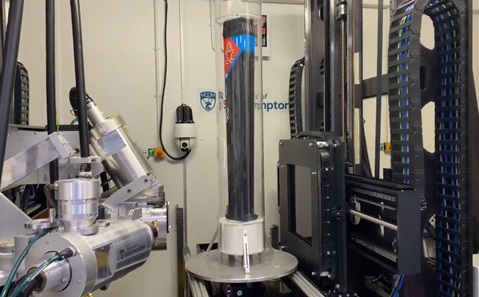 One of the foils is scanned
Dr Mark Mavrogordato, Director of Operations at the µ-VIS CT Imaging Centre , added: “It’s really wonderful to be able to use the kit here at the university to help Sam, and it’s great that we have students also involved in research to support Sam.”
Sam , 31, is a former junior world champion and represented the British Sailing Team in windsurfing at the 2024 Olympic Games, in which he came fifth.
He said: “I’m so grateful to have the opportunity to work with the University of Southampton. Being able to assess and test the foils using the university’s facilities and knowledgeable staff and students is really reassuring, has given us deep insights into the kit’s performance and make-up.”